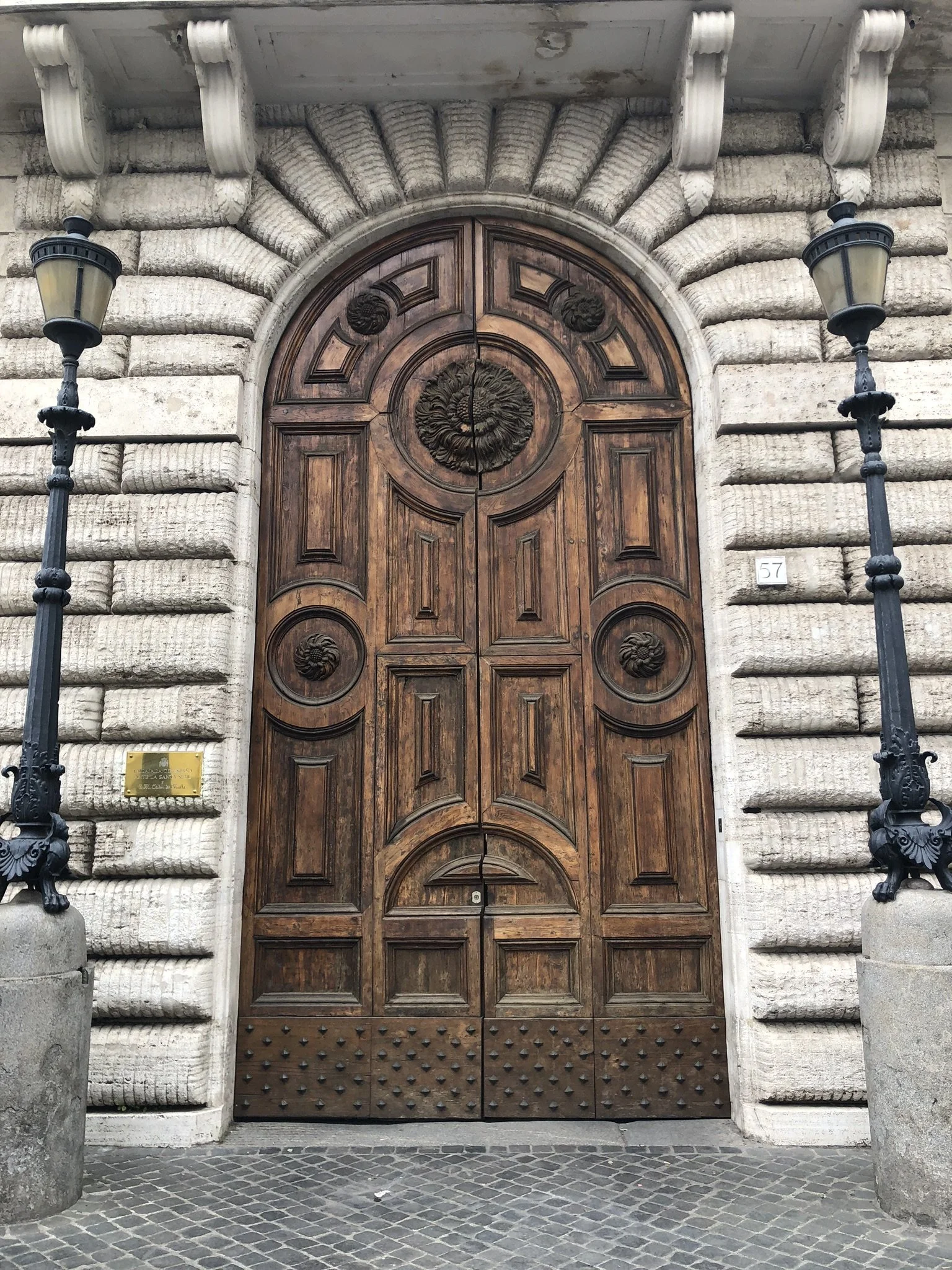
Perhaps because where I live now, I find myself yearning for architecture like this. Buildings with weight. Entrances that make you wonder what came before you. Calgary has fragments of that history in its heritage buildings, but in the newer parts of the city, moments like this are harder to stumble upon.
And this is certainly a moment.
The enormous timber doors sit within an arched opening surrounded by deeply rusticated stone. Their panels are carved rather than merely assembled; even the lower portions, studded with iron, have been considered. On either side stand two lanterns, almost improbably tall. In daylight they give the entrance ceremony. At night, I imagine, they give it romance.
There was once an extraordinary importance placed on an entrance.
In Renaissance Florence especially, the façade of a palazzo communicated something before a visitor ever crossed its threshold. Architecture could speak of permanence, dignity, family, prosperity and belonging. Rusticated masonry—the heavily textured stonework we see here—became one of the defining features of Florentine palaces. The city still preserves extraordinary examples of this architectural language.
I wonder what this door was intended to say.
You have arrived?
You are welcome here?
Or perhaps simply:
This place will endure.
I don't know exactly how old the door is. It may have been repaired, replaced or altered many times while the building around it lived on. And somehow that uncertainty makes me more curious.
How many hands have reached for it?
How many people have stood outside waiting to be admitted?
Children coming home. Deliveries arriving. Guests expected. Guests unexpected. Arguments carried through it. Celebrations spilling out of it. Ordinary mornings when no one stopped to think about the beauty of the entrance at all.
A door is such a practical thing. It protects. It divides public from private. It lets us decide when the outside world may enter.
But perhaps that is why humans have made them beautiful for so long.
We understood that crossing a threshold meant something.
And maybe what I miss when I look at this photograph isn't Florence itself so much as this old idea that the things we encounter every day deserve consideration. That utility and beauty don't have to be separate. That even an entrance can offer something to the street.
Something worth noticing.
Something worth preserving.
Something worth finding.