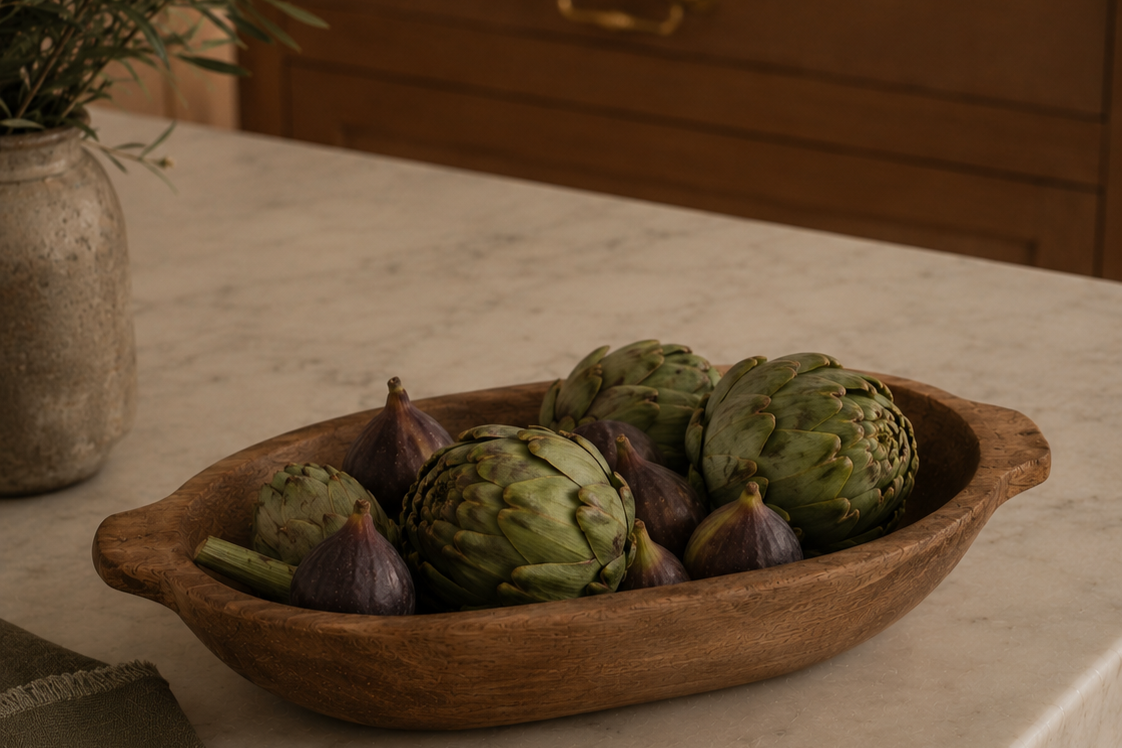
I suspect it may be mango wood — warm, dense and commonly used for hand-carved pieces in India. Its elongated form reminds me of old dough bowls and harvesting troughs: practical objects made from a single piece of timber, hollowed slowly by hand.
I imagine the maker beginning with a rough block of wood, tracing the oval by eye, then working inward with a chisel. The shallow handles were likely never added at all, but simply left behind as the rest of the form was carved away.
There is something I love about that idea. That an object can begin as excess material, and become itself through what is carefully removed.
The bowl is imperfect in all the right ways. The grain changes direction. The rim is not completely uniform. It carries the evidence of having been shaped rather than manufactured.
And now it sits on our kitchen island, full of seasonal givings — serving a purpose that is ordinary, useful and beautiful.
Sometimes that is enough of a story for me.